
Digital Office: How to Build a Company Without Walls
- Kahla Marketing
- Nov 17, 2025
- 3 min read

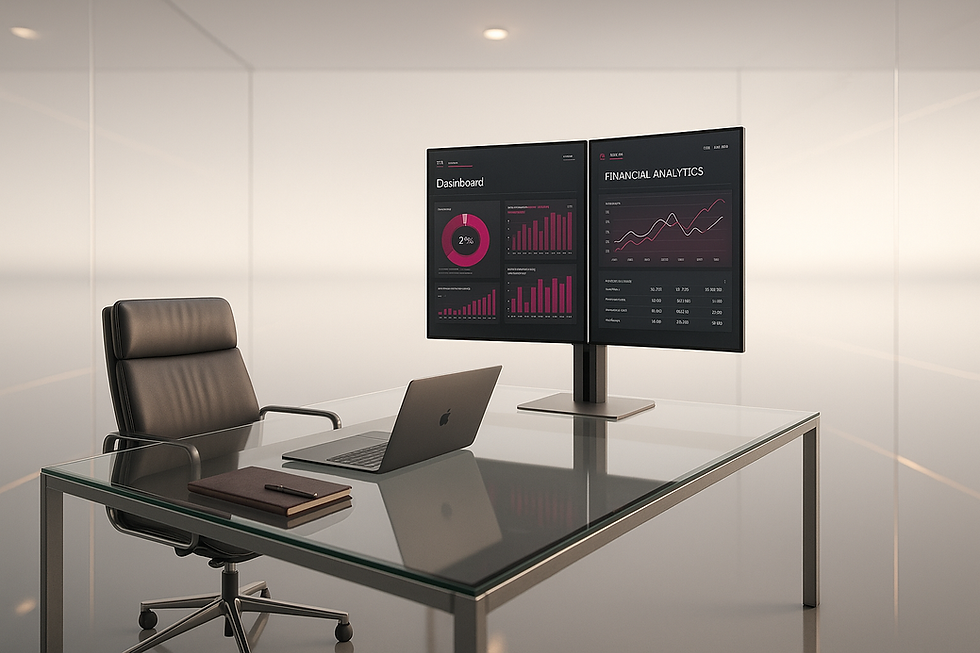
For decades, success had a physical address. It was that office with panoramic windows, the logo engraved on the wall, and a secretary answering calls in your name. But 2025 changed the rules: the world’s most profitable companies no longer have receptions, cubicles, or fixed schedules. And yet, they make millions.
Today, space no longer defines power.
The digital office isn’t just a trend; it’s a mindset that’s reshaping the way we do business. An entrepreneur with a laptop, a good connection, and structure can compete with a company that occupies an entire floor.
From Physical Space to Digital Ecosystem
The pandemic accelerated something that was already forming: the decentralization of work.70% of startups born between 2020 and 2025 have no physical office. They operate from coworking spaces, cafés, or homes turned into creative hubs. But what do they have in common? Clear processes, connected tools, and a strong professional identity.
Your digital office is not a place. It’s in the way you organize information, communicate, and project your brand.
The New Architecture of Success
If the key used to be “location, location, location,” now it’s “structure, perception, and efficiency.”Think of it like this:
Your website is the reception desk.
Your professional email is the direct line.
Your Google Drive or Notion are the file cabinets.
Your social media are the hallways where clients observe your culture.
And you, the founder, are both the architect and the janitor. The advantage: you can reconfigure that office in a matter of hours.
Remote Mindset: The New Discipline
Working from home doesn’t mean working without structure. Successful digital companies have clear routines, defined workflows, and visual systems. The remote mindset relies on three pillars:
Autonomy: No one tells you what to do; you set your own metrics.
Organization: Without order, chaos multiplies digitally.
Professional presence: Even if no one sees you, everything you send (email, document, design) reflects who you are.
Fun fact: Stanford studies show that remote workers increase their productivity by 13%, provided they have organized environments and fixed routines.
The Tools That Replace Walls
Your “invisible office” needs digital foundations. These are the basics:
Google Workspace: your address, inbox, and connected documents.
Notion or ClickUp: your desk, where everything becomes visible.
Canva Pro or Figma: your creative department.
Zoom / Meets: your meeting room.
CRM (HubSpot, Pipedrive, or Zoho): your client database.
Stripe or PayPal: your digital cash register.
Each tool serves a real function. The secret lies in integrating them and maintaining coherence under a single brand name and aesthetic.
Branding as Virtual Décor
In a physical office, paintings and colors express culture. In a digital office, branding does that job. Color psychology, minimalist design, and visual coherence create a perception of solidity—even if you’re working from your living room.
94% of first online impressions depend on visual design, not content. Your logo, color palette, typography, and even your profile photo are the digital equivalent of a pristine reception desk.
Fun fact: The human brain processes images 60,000 times faster than text. That’s why an image consistent with your brand has more power than a long presentation.
Communication Flow: The Pulse of Professionalism
The way you communicate determines whether your business feels improvised or professional. Well-written messages, personalized email signatures, and timely responses build authority. Every digital touchpoint should express the same values: organization and clarity.
In successful digital companies, even automated messages are written with a human and empathetic tone. Because branding also lives in language.
The Interior Design of Mental Order
Digital order reflects mental order. A cluttered mind creates chaotic folders, unanswered emails, and scattered decisions. A focused mind turns each tool into an extension of thought. That’s why building a digital office is not only about software—it’s about self-awareness and purpose.
And the Human Touch?
Paradoxically, the more digital a company is, the more it needs humanity. Faceless brands feel cold—and cold brands don’t sell. Your presence, even if virtual, must feel warm, empathetic, and real. In the digital age, warmth is something you program.
The secret isn’t to become more technological—it’s to humanize technology.
Building your digital office isn’t a technical step; it’s an evolution of identity. It’s not just about digitizing processes, but designing a structure that reflects who you are, what value you bring, and how you work.
The physical space may disappear, but the perception of professionalism must remain.
And in a world where clients trust what you project before what you say, having a well-designed digital office is your new seal of authority.


Comments